
January Issue
|
BooksBeat
Basic
|

|
Rachael Ray Moves to Atria; Gets Imprint (and QR Codes)
Ray tells the WSJ she wants to make her new cookbooks "exciting for people using their Nooks or iPads" and says she was attracted by a Tom Watson golf book Atria published last year that used QR codes editorially to link to instructional videos. (Yes, this is the first known example of QR codes actually benefiting a publisher.) Atria says they will use QR codes in Ray's THE BOOK OF BURGER, due in June, to link to instructional videos as well.
Following the dealmaking model-of-the-moment, Ray will have an imprint at Rachael Ray Presents, covering "titles on an array of topics." Among those authors promised imprints in the last year or so are:
Anthony Bourdain (Ecco) Dennis Lehane (William Morrow) Glenn Beck/Mercury Ink (Simon & Schuster) Deepak Chopra (Harmony) Chelsea Handler/Borderline Amazing (Grand Central)
Independent Bookstores Not Doomed
Here’s how they can fight back against Amazon.
by Farhad Manjoo
Many defenders of bookstores countered that by focusing on dollars and cents, I’d missed the whole point of these establishments. Bookstores, it turns out, don’t primarily exist to sell books—instead, they’re more like bars for readers. “Bookstores provide a space to meet friends, cruise for a date, and hide out when you have nothing to do on a Saturday night,” Will Doig wrote at Salon. I suspect that many bookstore lovers agree with Doig, which is exactly why many of these shops are going out of business. Bars can survive because alcohol is an extremely profitable good. Books aren’t—so if you think of your favorite bookstore as a comfortable spot to find well-read potential mates rather than as a place for commerce, you’re not helping its owner.
If you want bookstores to stick around, you should root for them to improve the way they sell stuff. Booksellers won’t survive the Amazon onslaught by merely wagging their fingers at the retail giant. Their only hope is to match the commercial innovations Jeff Bezos has brought to shopping. Indeed, this applies to all retailers, not just bookstores. The Internet has revolutionized how we buy stuff, but the main beneficiaries of this revolution have been warehouse companies like Amazon rather than firms that maintain a physical presence in your neighborhood. But it doesn’t have to be this way. This month, Amazon offered customers a discount to purchase stuff online while they were shopping at local establishments. It’s time neighborhood retailers fought Kindle Fire with Kindle Fire. Indeed, tablets and smartphones could be store owners’ best weapons against Jeff Bezos—if only they’d embrace them. Advertisement
Take reviews and recommendations. Pretty much everyone uses the Web to research products before they purchase them. Amazon has turned this fact into a competitive advantage; by collecting and curating reviews for more than a decade—and by creating an efficient recommendations engine based on millions of purchase decisions—the firm has become the first place many people look for product information. This database, which Bezos’ firm spent a huge amount of time and money to build, can just as easily be harvested by local retailers who invested nothing in its creation. If I ran a hardware store, I’d put up a sign encouraging in-store research: “Looking for a drill? People on Amazon love the Black & Decker 9099KC. We offer free Wi-Fi, so feel free to pull out your phone and browse online reviews!” Bookstores could do the same thing: “Confused about which baby sleep-training book is best? The No-Cry Sleep Solution gets nearly 5 stars on Amazon.”
Bronco Quarterback Sets More Records
Readership "is beyond the evangelical world and NFL fans now," said HarperOne president and publisher Mark Tauber. "There's just sort of a general intrigue about what drives this guy."
"To write what is worth publishing, to find honest people to publish it, and get sensible people to read it, are the three great difficulties in being an author." - Charles Caleb Colton
What Literature Owes the Bible
by Marilynne Robinson
The Bible is the model for and subject of more art and thought than those of us who live within its influence, consciously or unconsciously, will ever know.
Old Jonathan Edwards wrote, “It has all along been God’s manner to open new scenes, and to bring forth to view things new and wonderful.” These scenes are the narrative method of the Bible, which assumes a steady march of history, the continuous unfolding of significant event, from the primordial quarrel of two brothers in a field to supper with a stranger at Emmaus. There is a cosmic irony in the veil of insignificance that obscures the new and wonderful. Moments of the highest import pass among people who are so marginal that conventional history would not have noticed them: aliens, the enslaved, people themselves utterly unaware that their lives would have consequence.
The great assumption of literary realism is that ordinary lives are invested with a kind of significance that justifies, or requires, its endless iterations of the commonplace, including, of course, crimes and passions and defeats, however minor these might seem in the world’s eyes. This assumption is by no means inevitable. Most cultures have written about demigods and kings and heroes. Whatever the deeper reasons for the realist fascination with the ordinary, it is generous even when it is cruel, simply in the fact of looking as directly as it can at people as they are and insisting that insensitivity or banality matters. The Old Testament prophets did this, too.
Their Noonday Demons, And Ours
By John Plotz
This probably strikes you as an extremely, even a uniquely, modern problem. Pick up an early medieval monastic text, however, and you will find extensive discussion of all the symptoms listed above, as well as a diagnosis. Acedia, also known as the “noonday demon,” appears again and again in the writings of the Desert Fathers from the fourth and fifth centuries. Wherever monks and nuns retreated into cells to labor and to meditate on matters spiritual, the illness struck.
These days, when we try to get a fix on our wasted time, we use labels that run from the psychological (distraction, “mind-wandering” or “top-down processing deficit”) to the medical (A.D.H.D., hypoglycemia) to the ethical (laziness, poor work habits). But perhaps “acedia” is the label we need. After all, it afflicted those whose pursuits prefigured the routines of many workers in the postindustrial economy. Acedia’s sufferers were engaged in solitary, sedentary, cerebral effort toward a clear final goal — but a goal that could be reached only by crossing an open, empty field with few signposts. The empty field is the monk’s day of spiritual contemplation in a cell besieged by the demon acedia — or your afternoon in a coffee shop with tiptop Wi-Fi. In the later Middle Ages, monks performed fewer solitary tasks, and as the historian Andrew Crislip has shown, their vulnerability to the torments of acedia diminished. But for early medieval writers, acedia’s symptoms were so prolific as to be often contradictory.
For St. Benedict, the affliction took the shape of “a little black boy pulling the monk away by the hem of his garment,” while to the great fourth-century ascetic Evagrius it sometimes appeared as “demons that touch our bodies at night and like scorpions strike our limbs.” Gluttony and laziness can betoken acedia, one Desert Father, St. John Cassian, warns. However, “excesses meet” and “reluctance to eat and . . . lack of sleep put me in much greater danger.” The only real constant, during acedia’s heyday, was that it prevented monks and nuns from keeping their minds on their tasks, and their bodies in the right place. “Have you deserted your cell?” Basil the Great asks. “Then you have left continency behind you.”
If the diagnoses in medieval texts were so psychologically acute, it’s very likely because the most ferocious accusers and denouncers were themselves acedia sufferers. Today, too, it takes an acediac to know acedia. When I read Cassian on “disgust with the cell,” I look around my own office and sigh deeply; and I greet like an old friend the monk whose gaze “rests obsessively on the window” while “with his fantasy he imagines the image of someone who comes to visit him.” Cassian’s description of acedia as mental drift, meanwhile, perfectly encapsulates the pointless and random detours that stop me from bearing down on a particular page: “The mind is constantly whirling from psalm to psalm, . . . tossed about fickle and aimless through the whole body of Scripture.”
Finding My Religion
by Joshua Hammer
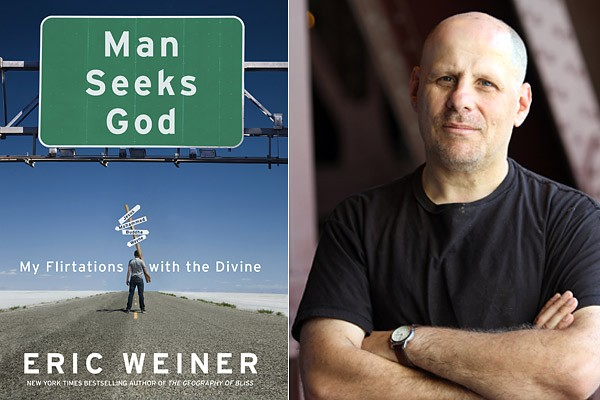
Eric Weiner’s “Man Seeks God: My Flirtations With the Divine” nimbly and often hilariously straddles the fence between the two genres. A former war correspondent for National Public Radio, Weiner is also the author of “The Geography of Bliss: One Grump’s Search for the Happiest Places in the World.” In that best-selling romp, he ditched the hellhole beat for a year and wandered the globe, from Bhutan to Iceland to Switzerland, looking for countries with a high “happiness index.” His new ramble begins after doctors mistake a nasty bout of intestinal gas for something far more dire. Weiner gets the scare of his life, and after a nurse confronts him in his hospital room (“Have you found your God yet?”) this self-described “Confusionist” sets off on a journey through five countries and eight religions to figure out which faith fits him best.
As Weiner explains in his introduction, he was born into a family of “gastronomical Jews” whose sense of a divine presence began and ended in the kitchen: “If we could eat it then it was Jewish and, by extension, had something to do with God. As far as I was concerned, God resided not in Heaven or the Great Void but in the Frigidaire, somewhere between the cream cheese and the salad dressing. We believed in an edible deity, and that was about the extent of our spiritual life.”
But that period of apathy ends with Weiner’s fear-of-death experience. Each subsequent chapter begins with a Craigslist-style personal ad, a plea from a “CWM” (Confusionist White Male) looking for divine inspiration. “Craves sanity and peace of mind,” he writes before heading off to Katmandu to explore the concepts of karma, suffering and reincarnation with Buddhist scholars, including a mystic from Staten Island named Wayne.
How Many Self-Published Authors Bestsellers in 2011?
Meanwhile, a user of Penguin start-up Book Country, Kerry Schafer, elicited interest from agent Deidre Knight for her fantasy novel BETWEEN, and made a two-book deal with Susan Allison at Penguin's Ace shortly thereafter. Allison also spotted Schafer's work on the web site and contact her directly as Knight was reading the manuscript. (Schafer's first novel posted on the site, about geriatric vampires in a nursing home, had not brought any publishing interest.) To round out our 2011 lists and reviews, we've compiled an informal account of all of the self-published ebook authors to make the NYT bestseller lists last year with an original work (thus we are not including reissues or short-form pieces). Contrary to the popular impression, the total number is...11. The authors, along with the date of the first appearance on the list, are:
Nancy Johnson (2/20) Victorine Lieske (3/6) Stephanie McAfee (3/27) Heather Killough-Walden (5/1) John Locke (5/8) Courtney Milan (7/10) Darcie Chan (8/28) Chris Culver (9/4) Rick Murcer (9/4) CJ Lyons (9/11) Bits & Bytes Get Thousands of Additional Listings for AmSAW PROFESSIONAL MEMBERS Today
FICTION Debut Margaret Wurtele's THE GOLDEN HOUR, set in war-torn Italy, and following the German army's invasion of her village, a young Italian woman risks her life to defy the injustice surrounding her, in this novel of forbidden love, to Claire Zion at NAL, by Marly Rusoff at Marly Rusoff & Associates (World English).
P. L. O'Sullivan's LACE CURTAIN IRISH, a family saga set in Chicago that encompasses the conflict between Irish immigrant parents and the first American born generation, to Cian O hAnnrachainn at Newcastlewest Books, in a nice deal, for publication in March 2012.
Inspirational Lily George's CAPTURING THE LIEUTENANT, in which a beautiful but impoverished young seamstress must decide between true love wit ha wounded Waterloo veteran or a life of comfort as mistress to one of the richest lords in England, to Melissa Endlich at Harlelquin Steeple Hill, by Mary Sue Seymour at The Seymour Agency.
Mystery/Crime Jay Stringer's OLD GOLD, pitched in the tradition of Ken Bruen and early Dennis Lehane, the hero is a half-Romani ex-cop who finds himself caught between two competing drug families in Britain's Black Country when he is framed for the murder of a mysterious young woman he met only the night before, to Andrew Bartlett at Thomas & Mercer, in a three-book deal, by Stacia Decker at the Donald Maass Literary Agency (World English plus Germany).
Women's/Romance Joyce Geissinger's THE DAUGHTER, first in the new IKATI series, in which a young woman discovers she is heir to a dynasty of secretive, shape-shifting predators, and finds herself caught in a centuries-old battle between two enemies who will to stop at nothing to annihilate one another, to Eleni Caminis at Montlake Romance, in a two-book deal, for publication in 2012, by Marlene Stringer at Stringer Literary Agency (World).
Children's: Picture book Dana Sullivan's OZZIE AND THE ART CONTEST, the story of a Blue Heeler named Ozzie, who is bursting with creativity and is sure he'll win the kindergarten art contest, to Barb McNally and Heather Hughes at Sleeping Bear Press, in a nice deal, for publication in spring 2013, by Anna Olswanger at Liza Dawson Associates (World). aolswanger@lizadawsonassociates.com
NONFICTION Advice/Relationships Walter Riso's LOVE, DON'T SUFFER, offering advice for those who are suffering from being with the wrong person, from feeling a diminishing of desire, or simply from lack of affection, and a second book, LOVE OR DEPENDENCE?, to Jaime de Pablos at Vintage Espanol, in a nice deal, for publication in 2012, by Anna Soler-Pont at Pontas Literary & Film Agency (US Spanish).
Cooking Peggy Sweeney-McDonald's MEANWHILE, BACK AT CAFE DU MONDE: THE LOUISIANA MONOLOGUES, stories and recipes of performers at the Meanwhile, Back at the Cafe Du Monde live shows in Baton Rouge, New Orleans and Shreveport, to Nina Kooij at Pelican, in a nice deal, for publication in spring 2012, by Anna Olswanger at Liza Dawson Associates (World). aolswanger@lizadawsonassociates.com
Memoir Journalist Sharron Kahn Luttrell's WEEKENDS WITH DAISY, about her year co-raising Daisy, a yellow lab puppy, to become a service dog, with a prisoner who'd already spent half of his life behind bars for a violent crime committed as a sixteen-year-old, to Abby Zidle at Gallery, for six figures, in a pre-empt, by Sorche Fairbank at Fairbank Literary Representation (world English). Translation: Books Crossing Borders bc@bookscrossingborders.com Film rights sold to CBS Films, in a six-figure deal, in a pre-empt, by Luke Sandler of The Gotham Group.
A collective group of anonymous US soldiers aka J. B. Walker's NIGHTCAP AT DAWN: American Soldiers' Counterinsurgency in Iraq, about their time serving on the front lines in Iraq -- which first appeared as a free ebook, to Jennifer McCartney at Skyhorse, for publication in Spring 2012. jmccartney@skyhorsepublishing.com
Pop Culture Leandra Medine's MAN REPELLER, a book of humorous essays inspired by the fashion blogger's realization that her style clashed with her romantic life, to Amanda Englander at Grand Central, by Michael Klein at Maxx Sports & Entertainment (World).
Reference Alex Palmer's WEIRD-O-PEDIA: The Ultimate Book of Strange, Surprising, and Incredibly Odd Facts about (Supposedly) Ordinary Things, the next time someone tells you smugly that starfish have no brains, you can counter with any one of these 1,045 weird facts (do you know what "achoo" stands for?) and remain king or queen of the cocktail (or kegger) chatter, to Jennifer McCartney at Skyhorse, for publication in Spring 2012 (World). jmccartney@skyhorsepublishing.com
General/Other Andrea Polard, PsyD's A UNIFIED THEORY OF HAPPINESS: An East-Meets-West Approach to Fully Loving Your Life, an original and practical contribution to the literature on happiness, providing a clear model for integrating the Western psychological understanding of ambition, goal orientation, and healthy relationships with Eastern spiritual, contemplative and receptive approaches that leads the reader to develop a fully engaged life of joy and contentment, to Jennifer Brown at Sounds True, for publication in June 2012 (World).
|





More Breaking Book News
The following book-industry
news appears in real-time as it becomes
available in order to meet your ever-expanding need to know
what's happening (and to whom) on Publisher's Row.
| Books & Authors - MagPortal.com |
|
|