
July BASIC Issue
|
BooksBeat
|
|
International Crime New Publishing Hottie?
It seems a certain Swedish hacker heroine with a dragon tattoo has paved the way for a surge of international crime fiction.
Spurred by the popularity of Swedish writer Stieg Larsson's trilogy, which has sold more than 40 million copies world-wide, U.S. publishers are combing the globe for the next big foreign crime novel. While major publishing houses have long avoided works in translation, many are now courting international literary agents, commissioning sample translations, tracking best-seller lists overseas and pouncing on writers who win literary prizes in Europe and Asia. The result is a new wave of detective fiction that's broadening and redefining the classic genre.
In the coming months, Minotaur Books, a mystery-and-thriller imprint of St. Martin's, will publish new crime and suspense fiction from Iceland, Japan, Nigeria, South Africa and, naturally, Sweden. A few years ago, most of the imprint's international authors were British. "A lot of publishers are looking at this because they don't want to miss the next Stieg Larsson," says Kelley Ragland, Minotaur's editorial director.
Some have pegged Japan as the next crime-writing hotspot. Literary agent Amanda Urban of International Creative Management, who represents Cormac McCarthy and Toni Morrison, took on Japanese suspense and crime writer Shuichi Yoshida, a best-selling author in Japan, because she saw his novels as literary works with commercial potential. "Crime really crosses over," says Ms. Urban.
Author Jefferson's "Freudian Slip"
In an early draft of the Declaration of Independence, Jefferson wrote the word "subjects," whenever he referred to the American public. He then erased that word and replaced it with "citizens," a term he used frequently throughout the final draft. The Library released news of the struck word for the first time on Friday, July 2.
Fenalla France, a research chemist at the Library, said her lab made the discovery last year by using hyperspectral imaging, using a high resolution digital camera that compiles a series of images to highlight layers of a document. Some of those invisible layers include erased text and even fingerprints that pop into view on a computer screen.
In switching from "subjects" to "citizens," France said it appears Jefferson used his hand to wipe the word out while the ink was still wet. A distinct brown smudge is apparent on the paper, although the word "subjects" is not legible without the help of the digital technology.
"This has been a very exciting development," France said, calling the findings "spine-tingling." Historic, handwritten documents reveal clues about the past that word processors cannot illuminate, said James Billington, librarian of Congress.
"It shows the progress of his mind. This was a decisive moment," Billington said. "We recovered a magic moment that was otherwise lost to history."
Accompanied by police escort, the document was unveiled outside its oxygen-free protective case for the first time in 15 years for an additional round of hyperspectral imaging. It normally can only be viewed through a 130-pound oxygen-free safe.
Donning a pair of white researchers' gloves, Maria Nugent, director of the Library of Congress' top treasures collection, slowly lifted a piece of off-white corrugated cardboard to reveal the rough draft of the Declaration, which includes handwritten corrections by both John Adams and Benjamin Franklin.
"That's a pretty good editorial committee," said Billington, who was present for the procedure. The rough draft was written on two sheets of white legal-sized paper, on both the back and front sides of the sheets.
The document was returned to the library's vault on Friday after the testing. A copy of the rough draft of the Declaration can be viewed online at http://www.myLOC.gov.
The "Sexing-Up" of Anne Frank
Now Sharon Dogar, who specialises in novels for teenagers, has written a book of fictional diaries of Peter van Pels, Anne's close friend who lived in the same building while she was hiding in Amsterdam.
The diaries, which are to be published in the autumn, include graphic accounts of Peter’s desire for Anne and intimate scenes between the two, according to The Sunday Times The book has been criticised by Buddy Elias, Anne’s first cousin, who chairs a charity devoted to her memory. The 84-year-old, who lives in Switzerland, used to play with his cousin when they were youngsters.
He said he learnt a lot about her and Peter from Anne’s father Otto, who survived the war and had the diaries published in 1947. Otto died in 1980.
Elias has read an advance copy of Annexed, named after the annexe of the office building where the Frank and van Pels families lived in hiding.
“Anne was not the child she is in this book,” he said. “I also do not think that their terrible destiny should be used to invent some fictitious story.”
“From what Otto told me about Peter, he was very shy but in this book he is given a character he did not possess,” he said.
Anne, who wrote her diary from the summer of 1942, when she had just turned 13, until August 1944, died in Belsen of typhus in March 1945 after being transferred there from Auschwitz. Charlie Sheppard, editorial director of Andersen Press, the publisher, said that Dogar “feels they had sex, but this was taken out from an earlier version”.
“Sharon reread and reread Anne’s diaries, and is in no doubt that they were in love” she added. “They also talk about sex in the diaries. After all, the hormones of both were raging.” “From Anne’s diary it is clear that a romance flared up for a few months, during which they probably kissed and cuddled,” said Deborah Moggach, who adapted the diaries for an acclaimed BBC series in 2008. “She then cooled on him.”
Dogar told The Sunday Times she did not want to discuss the book in detail. She said it was “pure conjecture” that Anne and Peter ever made love. She also argued that the most important part of her book is Peter’s time in the Nazi camps.
DOA: The American Novel
Book pundits in the United States are being urged to line up on one side or other this summer: Is the American novel finally dead or not? The row began when the controversial critic Lee Siegel wrote a piece for the New York Observer declaring that the American public no longer talk about novels and that this creative form, once so full of fire, has lost its spark for ever.
"For about a million reasons," Siegel claimed, "fiction has now become a museum-piece genre most of whose practitioners are more like cripplingly self-conscious curators or theoreticians than writers. For better or for worse, the greatest storytellers of our time are the non-fiction writers."
As the Samuel Johnson Prize for non-fiction, awarded on Thursday in London, recognised the importance of the new book by American journalist Barbara Demick, Nothing to Envy: Real Lives in North Korea, the debate Siegel has re-started raged on in books pages and on literary websites. Will American fiction ever compete again with non-fiction for contemporary relevance, critics in both camps are asking.
Siegel's assault on America's novelists was prompted by the publication of the New Yorker's annual "20 Under 40" list of new writers, but it has exposed a bitterness at the heart of the world of books.
Railing against "the New Yorker's self-promoting, vulgar list" of favoured newcomers, Siegel smears the whole literary pack as being damagingly self-referential and led by the nose by publicists. Calling for new talent and new genres, he laments the fact that nobody bothered to question the "20 Under 40" selection.
The British critic James Wood, now perhaps the leading voice in literary journalism in America, is at the centre of the row. For Siegel, the prominence and fame of Wood – who writes for the New York Times – sums up the current crisis in fiction.
"May the gods bless my former New Republic colleague, and may he keep reviewing novels for another hundred years, but the very emergence of Mr Wood signals the decline of fiction, his driving passion," Siegel claims, going on to argue that the death of an artistic form is evident when the analysis of it has become so top-heavy.
Dead for a Century, Twain Says What He Meant
by Larry Rohter
Whether anguishing over American military interventions abroad or delivering jabs at Wall Street tycoons, this Twain is strikingly contemporary. Though the autobiography also contains its share of homespun tales, some of its observations about American life are so acerbic — at one point Twain refers to American soldiers as “uniformed assassins” — that his heirs and editors, as well as the writer himself, feared they would damage his reputation if not withheld.
“From the first, second, third and fourth editions all sound and sane expressions of opinion must be left out,” Twain instructed them in 1906. “There may be a market for that kind of wares a century from now. There is no hurry. Wait and see.”
Twain’s decree will be put to the test when the University of California Press publishes the first of three volumes of the 500,000-word “Autobiography of Mark Twain” in November. Twain dictated most of it to a stenographer in the four years before his death at 74 on April 21, 1910.
He argued that speaking his recollections and opinions, rather than writing them down, allowed him to adopt a more natural, colloquial and frank tone, and Twain scholars who have seen the manuscript agree.
iPhone Apps Help Best-Selling Books
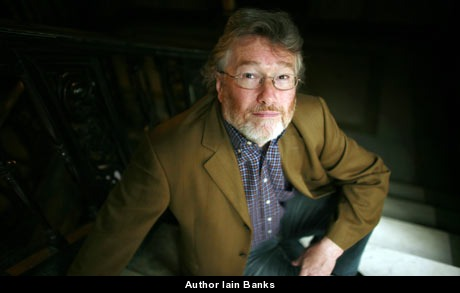
Authors such as Iain Banks and Martina Cole are increasingly supplementing book releases with apps full of bonus material
Mobile software company TradeMobile has worked with Banks's publisher Little, Brown to develop the free application for the iPhone, which launched on July 1. Readers who have bought the paperback of Banks's latest novel, Transition, will be able to scan a unique barcode on their edition with their iPhone, and companion features for the novel will be transmitted to their screen.
A best-selling author, the publishers also hope the new app may entice readers uninitiated into his complicated universe of difference worlds and civilisations. "For something as complicated as Transition it makes sense," said Banks. "It's very much like a DVD extras." The app also includes character biographies; after a "slightly anguished" email from his German translator, Banks realised that a character called Bisquitine might need her language and cultural references explaining.
"She appears toward the end of the novel and has an important part to play, and a very eccentric way of expressing herself," says the author. "It took half a day to write and three to explain."
Kirk Bowe at TradeMobile says: "You're able to tap in a page number and get back all the characters, scenes and locations which may be relevant to that page."
Author, 82, Lands First Book Deal
"Gobsmacked" Myrrha Stanford-Smith marks novel debut with The Great Lie
Stanford-Smith, a trained actor, has always had a passion for creative writing. After receiving positive feedback on a short children's story she sent in to BBC Radio Wales last summer, she secured a deal with publisher Honno for a trilogy based around her swashbuckling Elizabethan hero, Nick Talbot.
The adventure reignites, in fictional form, the rivalry between William Shakespeare and Christopher Marlowe. The book's 16-year-old Nick, the son of the late first Earl of Rokesby, runs away with a troupe of traveling players who take him to London where he soon comes to Marlowe's attention.
Stanford-Smith said of the deal, "I was gobsmacked. I had to put the phone down and ring them back as I was so taken aback by the whole thing. I had to pull myself together before I could even pick up the phone to call back.
"It was out of the blue. I'd been waiting for the manuscript to be sent back, really, rejected. It was such a wonderful surprise."
Born in Brighton and trained at the Guildhall School of Music and Drama before working with theatre director and impresario Sir Tyrone Guthrie in the West End, the author later moved into teaching and directing.
"It was so lovely to have the book in my hand with embossed cover," she said. "I read it again just for pleasure – to have my book, my words, in my hand as my very own book, it was wonderful. It's on the bookshelves now next to my favourite authors in pride of place with a gap for the next two in the trilogy."
After retiring to Anglesey in the 1990s, Stanford-Smith realized a life-long dream by founding Ucheldre Repertory Company. She still works with the company as both a director and teacher and is currently directing a production of Richard III for production this autumn.
B & N Offers New Low-Priced Nook
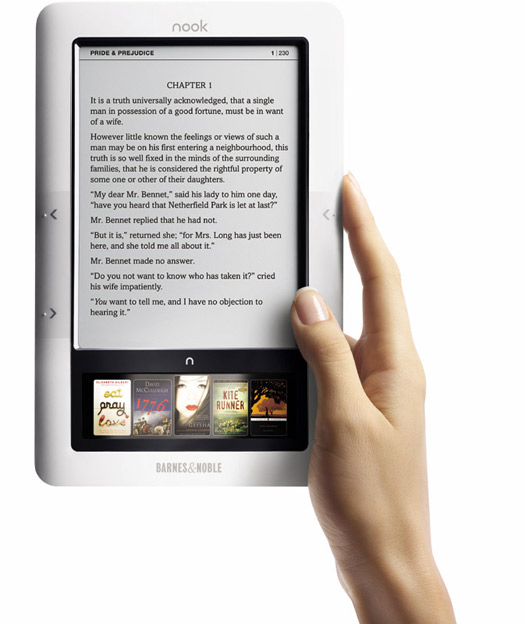
The new NOOK Wi-Fi offers all the features of NOOK 3G – a color touch screen for navigation and best-in-class E-Ink® display for a great reading experience – plus Wi-Fi connectivity. NOOK Wi-Fi is available online at www.nook.com and www.bestbuy.com.
Barnes & Noble’s new price for NOOK 3G marks the market’s first under-$200 dedicated full-featured eBook reader that offers both free 3G wireless and Wi-Fi connectivity. And Barnes & Noble continues to enhance the eReading experience for all NOOK 3G and NOOK Wi-Fi owners through its latest 1.4 software update, now offering even more places to connect to Wi-Fi for free and faster access to the content they want to read.
NOOK Wi-Fi eBook Reader marries innovative technology and sleek minimalist design with Wi-Fi connectivity. This latest addition to the NOOK family gives customers the opportunity to take advantage of the proliferation of both in-home and public Wi-Fi hotspots, where they can browse the Web and shop the Barnes & Noble eBookstore of more than one million eBooks, periodicals and other digital content.
With its latest software update for all NOOK devices (now available at www.nook.com/update), Barnes & Noble is offering all NOOK customers complimentary access to AT&T’s entire nationwide Wi-Fi network, including Barnes & Noble book stores which have previously been available to NOOK customers.
As part of the NOOK eBook Reader family, NOOK Wi-Fi features Barnes & Noble’s breakthrough LendMe™ technology, enabling customers to share eBooks with friends for up to 14 days. NOOK Wi-Fi also offers the same great in-store features like Read In Store™ to browse complete eBooks in Barnes & Noble stores at no cost, and More In Store™, offering free, exclusive content and special promotions.
“People who love to read will find tremendous value with the new NOOK Wi-Fi, the most full-featured, low-cost eReading device on the market, and our bestselling NOOK 3G now at an even lower price,” said Tony Astarita, Vice President, Digital Products, Barnes & Noble.com. “This expanded choice offers best-in-class, best-priced dedicated eBook Readers featuring eBook sharing, access to our vast eBookstore, great free and exclusive content and much more. And with expansion of fast and free Wi-Fi access beyond Barnes & Noble stores to thousands of AT&T Wi-Fi Hot Spots, we’re bringing additional freedom and flexibility to all NOOK 3G and NOOK Wi-Fi customers.”
Book Tip: Get Buffet To Plug You
An obscure book about the collapse of the German economy in the 1920s has become cult reading among leading financiers, after a tip from billionaire investor Warren Buffett.
by Matthew Moore, Telegraph
The collapse of the Weimar Republic cleared the way for Adolf Hitler’s Nazis to seize power in 1933. After Buffett tipped off a Dutch financier friend about the wisdom of Fergusson's analysis, his book became the talk of right-wing blogs and economics websites, with copies changing hands for up to £1,600.
Old Street Publishing, a small British publisher, has rushed out a new edition to meet demand. Fergusson, who worked for Lord Howe in the Foreign Office from 1984 to 1989, said that he hoped the renewed popularity of his work would bolster the case for swift budget cuts and fiscal conservatism.
His book emphasises how hyperinflation affected the lives of ordinary German people, not just the political and business elites.
The 78-year-old said: "In Britain today there is this debate between neo-Keynesians who want to postpone any tightening of the economy and those who say it should be done at once. To my mind it is a nondebate, because politically now is the only time tightening can be done. In a year or so it won't be possible, politically, any more.
"When governments are not strong or brave enough politically, finally the economy goes to pieces anyway.”
Buffet has amassed a fortune estimated at £30 billion. The financier to whom he recommended the book has not been identified, but claims to have bought hundreds of copies to send to the Dutch government and the European Central Bank.
Are You There, God?
How Christian YA novels are offering a surprisingly empowering guide to adolescence.
by Ruth Graham
Created as a "safe" alternative to mainstream fiction, books for Christian girls include wholesome heroines, lots of praying, and absolutely no cursing. And they're a big business. The Christy Miller and Sierra Jensen series—now Christian YA classics—have sold more than 2 million copies between them, and the Diary of a Teenage Girl books have sold more than 600,000 copies since 2008. Most Christian publishers have guidelines for taboo words and situations, and some also have in-house theologians vet content to make sure it adheres to "Biblical principles." Amid all of this piety, however, are explicitly positive—even feminist—messages like positive body image, hard work, and the importance of not settling for just any guy—that present a grounded alternative to the Gossip Girl landscape.
Though American Christians have had a sometimes wary relationship with fiction, the genre has a long history, starting with Pilgrim's Progress, John Bunyan's 17th-century allegory about a man named Christian making his way to the Celestial City. Series for Christian women and girls became widespread in the 19th century, and some from that era, including the Miranda trilogy by the prolific romance writer Grace Livingston Hill and Martha Finley's Elsie Dinsmore series about a pious preteen, are still kicking around.
The 20th century brought mainstream best-sellers with Christian themes, including Ben Hur, the Newbery Award-winner The Bronze Bow, A Wrinkle in Time, and C.S. Lewis' Narnia series. But backlash to loosening social mores also caused a resurgence of interest in more explicitly religious fiction with a stronger moralist vein. Catherine Marshall's best-seller Christy—published in 1967, the same year as the gritty, secular YA hit The Outsiders–became the new prototype for Christian-girl lit. The sweeping tale of a pious young woman teaching school in rural Tennessee sold millions of copies, inspired a hit miniseries, and remains the gold standard in Christian fiction for women—one of the most prestigious awards in the Christian fiction industry is the Christy. The awards added a Young Adult category in 2007.
In recent years, fiction for both Christian adults and teens has been expanding again. Methodist publisher Abingdon entered the fiction market in 2009, and the Christian academic publisher Hendrickson plans to launch a fiction line next year. Revell, founded by 19th-century evangelist Dwight L. Moody and now owned by the large evangelical Baker Publishing House, says it has recently increased its presence in YA fiction. Zondervan, the evangelical publisher of Rick Warren's The Purpose Driven Life, launched a YA arm in 2008. Some titles are sold in mainstream outlets, including Wal-Mart, but most are sold in Christian bookstores and at events like Thomas Nelson's touring Revolve conferences—"Helping girls learn about life, love, and God since 2005."
In the newest books, old-fashioned values are embraced for newfangled reasons. Modesty is endorsed, not because of shame, but because of self-respect and practicality: Protagonist DJ in Spring Breakdown opts for a one-piece swimsuit over a teensy bikini because, "I like to swim. And I like to move around." Besides, another character reflects later, "Sometimes subtle is sexy." The verse in Genesis that says humans are made "in the image of God" is frequently employed to reinforce positive body image. And where mainstream novels can be relentlessly brand-driven—even incorporating product placement—the most fashionable character in the best-selling Carter House Girls series is the one who rejects brand names in favor of thrift stores. Author Melody Carlson told me she created the Carter House Girls in direct response to the Gossip Girl series, because she feared that the latter shows realistic behavior but unrealistic or nonexistent consequences. Carlson says she doesn't like the word feminist, but that nonetheless she was raised to be one, which comes through in her work: "It never occurred to me that a woman should be less than her best."
Book Briefs: Gloomy Stats Dwindling Outlets
Thus far for 2010, Amazon Shares Upgraded; Half Price Books Posts Gains; and Stores Tighten Ranks
HC UK sales dropped 13.3%, while Random House declined to 9.8% and ceded additional market share to Hachette (tops at 16.2%, though sales still declined 5.5% for the year so far.)
Analyst Jack Murphy of William Blair raised his rating on Amazon from Market Perform to Outperform, saying that with a nearly 9% retail market share, the company "is well positioned to capture share of spending as consumers shift toward the online channel" and enjoy "a long duration of growth."
While same-store sales at big-box stores have continued to take a hit in the recession's aftermath, Half Price Books reported a 5% jump over the past year at its 110 stores, with a 5.6% same-store climb in San Antonio alone. With an eye on recent growth in e-readers and not wanting to be "the next Tower Records or Sound Warehouse," two recently failed retail chains, Executive VP for marketing and development Kathy Doyle Thomas says the company is "looking to see if we can buy used Kindles to sell and if there's a market for that."
The WSJ looks at what they deem to be ever-shrinking options for authors on tour in NYC. With store closures, it's become "far more problematic" to get a signing slot at one of the Manhattan branches of Borders or B&N, especially at the latter's Union Square venue, deemed the "biggest get". There's nary a mention of independent stores or alternative venues, and Susan Isaacs questions the general wisdom of signings: "I'm more concerned about the size of the advertising budget."
Bits & Bytes For thousands of additional listings, become an AmSAW Professional Member Today
Debut Rights to Michael Heyward at Text Publishing, for ANZ; Iris Tupholme at Harper Canada; Julia Schade at Fischer, at auction, in Germany; Mariaguilia Castagnone at Piemme, at auction, in Italy; Luciana Villas-Boas at Record in Brazil; Chris Herschdorfer at Ambo Anthos in Holland; Marie Misandeau at Sonatine in France; Sonia Draga at Draga, in Poland; Keter in Israel, by Gal Pikarski at the Pikarski Agency; and to Angela Sotiriou at Psichogios, in Greece. A film auction is looming. Rights: jake@convilleandwalsh.com
Thriller C.J. Carpenter's THE RETURNED and VIBRATIONS, featuring an Irish Catholic NYPD detective on the trail of a psychopath who is sending "good girls" to God by killing them, to Kate Miciak at Bantam Dell, by Doug Grad at the Doug Grad Literary Agency (World).
Women's/Romance Tessa Dare's next three Regency romances in a new series, to Tessa Woodward at Avon, in a good deal, by Helen Breitwieser at Cornerstone Literary (World English).
Joey Hill's VAMPIRE'S KEEPER, in which a reclusive vampire must teach young vampire children how to survive in a brutal adult vampire world all while guarding himself from Elisa, a beautiful marked servant who brings with her a threat unlike any he's prepared for, to Wendy McCurdy at Berkley, by Deidre Knight at The Knight Agency.
General/Other HUMMINGBIRDS author Joshua Gaylord's FRONTIERLAND, set in 1975 Orange County, interweaving the stories of a twelve year-old tomboy and an ex-beauty queen both searching for escape, moving to Marjorie Braman at Holt, by Josh Getzler at Russell & Volkening (World).
Children's: Middle grade 2007 Coretta Scott King/John Steptoe New Talent Award winner Sundee Frazier's BRENDAN BUCKLEY'S SIXTH-GRADE YEAR AND EVERYTHING IN IT, the sequel to BRENDAN BUCKLEY'S UNIVERSE AND EVERYTHING IN IT, in which he enters middle school and gets a baby sister, a possible girlfriend, and a chance to win a state science contest, to Michelle Poploff at Delacorte, for publication in 2012, by Regina Brooks at Serendipity Literary Agency (world).
Children's: Young Adult Debut author Elizabeth Miles's paranormal suspense trilogy, FURY, about three beautiful and vengeful teen sisters who exact karmic justice in a small town in Maine -- and the one girl who might have the power to stop them, to Jennifer Klonsky and Emilia Rhodes at Simon Pulse, in a very significant deal, at auction, in a three-book deal, by Stephen Barbara at Foundry Literary + Media, on behalf of Paper Lantern Lit (NA). Foreign: hgordon@foundrymedia.com NONFICTION Advice/Relationships Phil Cooke's JOLT YOUR LIFE, about understanding the radical power of change and how to leverage it for success in your business and personal life, to Joel Miller at Thomas Nelson, by Rachelle Gardner at WordServe Literary Group.
Business/Investing/Finance Ken Fisher's DEBUNKERY: Profit From Seeing Through Wall Street's Myths, to Laura Walsh at Fisher Investments Press, in a significant deal, for publication in October 2010, by Jeff Herman at the Jeff Herman Agency (world).
History/Politics/Current Affairs David Johnson's BATTLEFIELD ELECTION: U.S. Grant, William Tecumseh Sherman, Abraham Lincoln and the Election of 1864, a fascinating analysis of the political and military maneuvers that influenced the outcome of the crucial 1864 presidential election, to Steven Mitchell at Prometheus, for publication in 2011, by Alison Picard (World).
How-To NYT bestselling author MAKE IT FAST, COOK IT SLOW Stephanie O'Dea's TOTALLY TOGETHER, an organizational planner for busy families, to Denise Silvestro at Berkley, for publication in 2011, by Alison Picard (World).
Humor Ellen DeGeneres's untitled look at her life through her humor ("I found that between my talk show, American Idol and my late night blogging, I didn't have enough ways to express myself"), to Deb Futter at Grand Central, for publication in fall 2011, by Esther Newberg at ICM, Eddy Yablans at ICM, attorney Kevin Yorn and manager Eric Gold.
Memoir Denis Avey and Rob Broomby's THE MAN WHO BROKE INTO AUSCHWITZ, the true story of POW Denis Avey, who swapped places with Jewish prisoners from Auschwitz so he could see for himself the horrors occurring there, certain that "one day there would be a reckoning," to Da Capo, at auction, by Jason Bartholomew at Hodder (US). Foreign rights to Agir in Brazil, Lattes in France, Luebbe in Germany, Newton Compton in Italy, House of Books in the Netherlands, Planeta in Spain, by Alice Howe at Hodder. Translation: alice.howe@hodder.co.uk
Narrative Maggie Anderson's OUR BLACK YEAR, chronicling her family's attempt to support the underserved African-American community by investing in its economy -- and for one year patronizing only black-owned businesses, to Lindsay Jones at Public Affairs, by Kirby Kim at William Morris Endeavor (World English).
Religion/Spirituality Pulitzer Prize winning author Tom Hallman, Jr.'s AMAZING GRACE: TRUE STORIES OF THE POWER OF FAITH, stories of the power of the human spirit and the mystery of faith in our lives, based on a series of articles he contributed to Rick Warren's Purpose Driven magazine, to Philis Boultinghouse at Howard Books, for publication in 2012, by Noah Lukeman at Lukeman Literary Management (World).
|





 The
new popular source of girl power isn't a hyper-sexed Miley Cyrus video or
Candace Bushnell's recently published Sex and the City prequel about
Carrie Bradshaw's teen years. If you look past the Bible-study scenes,
young-adult novels from evangelical authors and publishers are offering
their young Christian readers a surprisingly empowering guide to
adolescence.
The
new popular source of girl power isn't a hyper-sexed Miley Cyrus video or
Candace Bushnell's recently published Sex and the City prequel about
Carrie Bradshaw's teen years. If you look past the Bible-study scenes,
young-adult novels from evangelical authors and publishers are offering
their young Christian readers a surprisingly empowering guide to
adolescence. 
More Breaking Book News
The following book-industry
news appears in real-time as it becomes
available in order to meet your ever-expanding need to know
what's happening (and to whom) on Publisher's Row.
| Books & Authors - MagPortal.com |
|
|